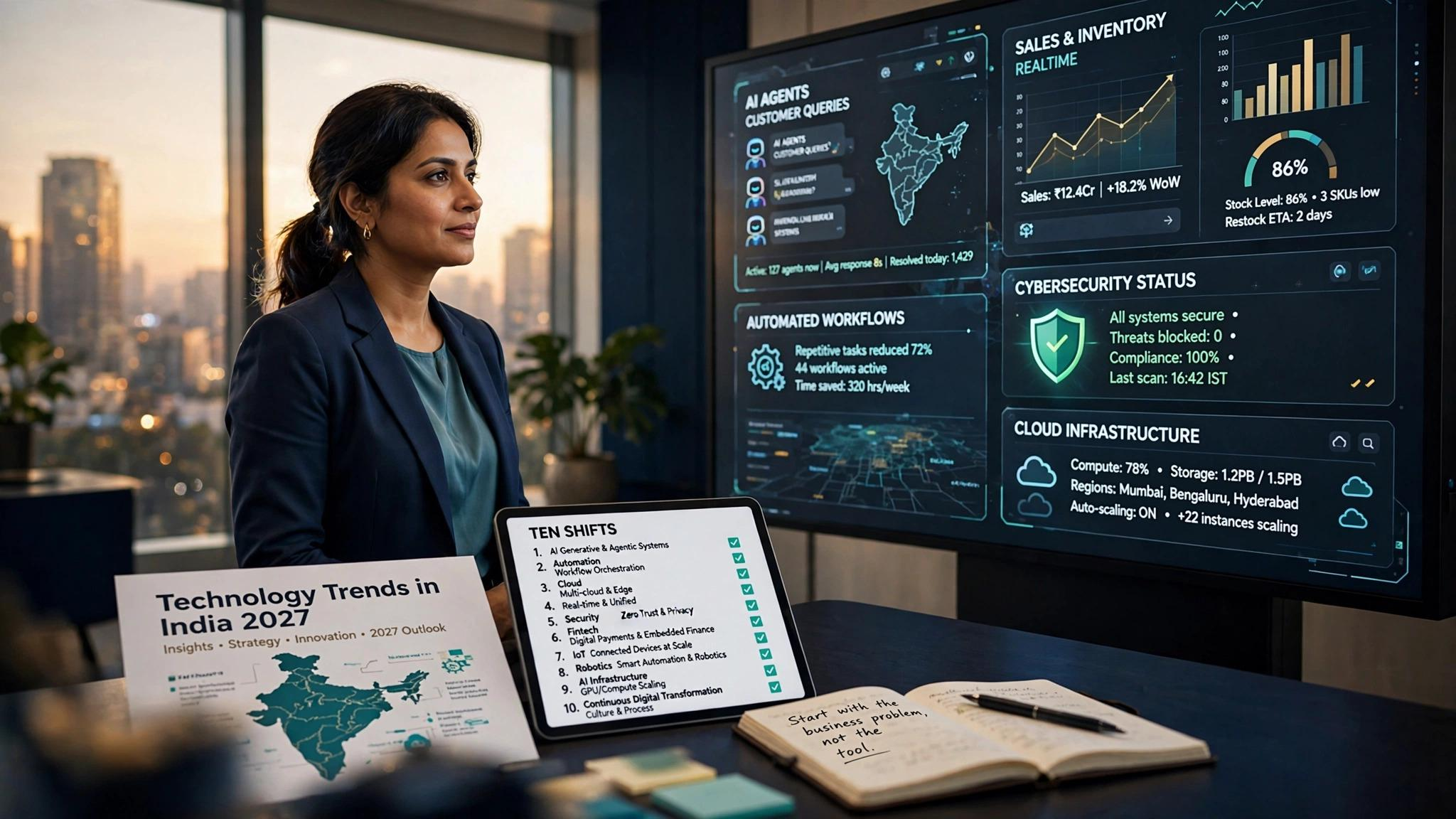

Introduction: Technology Is Becoming a Core Business Strategy
Technology trends in India are no longer something that lives exclusively inside the IT department, reviewed once a year during a budget cycle. AI, automation, cloud computing, and data analytics are actively reshaping everyday business operations — how customer service gets handled, how decisions get made, how quickly a company can respond to a shift in demand. Indian businesses across nearly every industry, not just technology-native startups, are adopting digital tools to improve productivity and sharpen the customer experience.
This shift matters because it changes what “staying competitive” actually requires. Understanding the technology trends shaping Indian businesses in 2027 isn’t just useful for CTOs anymore — it’s relevant to anyone making strategic decisions about where a company invests next. Here are the 10 technology trends most likely to influence Indian businesses through 2027, along with a practical framework for adopting them without wasting money on tools that don’t solve a real problem.
1. Artificial Intelligence Will Move Into Everyday Business Operations
Generative AI, AI assistants, and AI agents have moved well past the novelty phase. They’re increasingly embedded in customer service, marketing, business analytics, and everyday workflow automation — drafting responses, summarizing meetings, flagging anomalies in sales data before a human even notices.
This is exactly how AI will change Indian businesses in 2027: not as a single dramatic transformation, but as a steady embedding of AI into tasks that used to require dedicated staff or manual effort. Companies that treat AI as core operational infrastructure, rather than an experimental side project, are the ones capturing real efficiency gains from it.
2. AI-Powered Business Automation Will Reduce Repetitive Work
Administrative workflows, data processing, sales follow-ups, reporting, customer support, and document processing are all areas where automation is quietly cutting hours of manual work. This matters because it lets businesses improve efficiency without necessarily increasing headcount at the same pace as their workload grows.
This is a clear example of how AI and automation can transform Indian businesses at the operational level. A sales team that used to spend hours a week on manual follow-up emails can redirect that time toward actual selling, while automation handles the repetitive part of the process reliably in the background.
3. Cloud Technology Will Become More Strategic
Cloud infrastructure, SaaS tools, remote collaboration platforms, and scalable computing are shifting from a cost-saving IT decision to a genuine strategic advantage. Businesses that build on flexible cloud-based applications can scale computing needs up or down without the capital expense of maintaining physical servers.
This flexibility is one of the more practical new technologies for Indian businesses in 2027 worth prioritizing, especially for companies expecting variable or seasonal demand. Cloud-based data storage also makes it far easier for distributed teams to collaborate, which matters more as hybrid and remote work arrangements continue across Indian industries.
4. Data Analytics Will Drive More Business Decisions
Customer analytics, sales forecasting, market analysis, operational data, and predictive analytics are increasingly replacing gut-feel decision-making with evidence. Real-time dashboards let business leaders see what’s actually happening in their operations as it unfolds, rather than waiting for a monthly report to catch a problem after it’s already cost real money.
This is central to how Indian businesses can use emerging technology to make sharper decisions faster. A retailer that can see which products are underperforming in near real time can adjust inventory and marketing before a slow quarter turns into a genuinely bad one.
5. Cybersecurity Will Become a Business Priority
As digital dependency increases across nearly every function of a business, so does exposure to real cybersecurity risk. Identity protection, cloud security, employee security awareness, and data protection all need to become standard operating priorities, not afterthoughts addressed only after an incident.
This is one of the clearer future technology trends for Indian businesses that carries genuine downside risk if ignored. A single data breach can undo years of customer trust, which makes security investment a business continuity issue as much as a technical one.
6. Digital Payments and Fintech Will Continue to Evolve
Digital payments, embedded finance, B2B fintech, automated financial services, digital lending infrastructure, and financial management technology are all maturing quickly across Indian business. What used to be a simple “accept payment online” decision has expanded into a much broader set of financial technology choices.
This is among the business technology trends to watch in India most closely, since fintech infrastructure increasingly underpins how businesses manage cash flow, extend credit to customers, and handle B2B transactions that used to require lengthy manual processes.
7. IoT and Smart Operations Will Expand
Connected devices, smart manufacturing, logistics tracking, inventory monitoring, predictive maintenance, and connected retail are extending real-time visibility into physical operations that used to rely on manual checks and periodic audits.
These are genuine technology innovations shaping the future of Indian business, particularly in manufacturing and logistics, where a sensor flagging equipment wear before it fails can prevent costly downtime that a scheduled maintenance check might have missed entirely.
8. Robotics and Advanced Automation Will Reshape Industry
Manufacturing automation, warehousing robotics, logistics automation, and human-machine collaboration are moving from large enterprise pilots into more mainstream industrial use. This isn’t speculative, futuristic technology — it’s increasingly practical equipment solving real bottlenecks in production and fulfillment.
The businesses seeing the clearest returns here are focusing on specific, well-defined applications — a robotic arm handling one repetitive assembly task, an automated system managing warehouse picking — rather than trying to automate an entire facility at once.
9. AI Infrastructure and Semiconductor Technology Will Gain Importance
AI computing requirements are pushing semiconductor technology, data centers, and broader computing infrastructure into strategic business conversations that used to be purely a government or academic concern. Domestic technology capability in this space is becoming a genuine business consideration, not just a policy discussion.
This is one of the clearer emerging technology trends in India worth watching, because businesses building AI-dependent products increasingly need to think about where their compute actually runs and how resilient that infrastructure is, rather than assuming unlimited, cheap cloud capacity will always be available.
10. Digital Transformation Will Become a Continuous Process
Rather than treating digital transformation as a one-time project with a defined end date, businesses are increasingly updating technology continuously. Legacy systems get replaced gradually rather than all at once, employees need ongoing digital skills rather than a single training session, and AI, cloud, analytics, and automation increasingly work together rather than as separate initiatives.
This shift is exactly how technology will transform Indian businesses structurally over the next few years — technology strategy is becoming part of overall business strategy, not a separate track that runs alongside it.
What These Technology Trends Mean for Indian Businesses
A practical framework for approaching all of this, rather than adopting every trend at once:
- Start with business problems — Don’t adopt technology simply because it’s trending; identify a genuine bottleneck first.
- Measure ROI — Track productivity, revenue impact, cost savings, and customer impact, not just adoption for its own sake.
- Train employees — Technology adoption only works with people who have the skills to use it well.
- Strengthen security — Digital transformation should happen alongside cybersecurity improvements, not after a problem forces the issue.
- Scale gradually — Test new technology in one function before deploying it across the entire organization.
Staying Updated With India’s Business Technology Landscape
Businesses also need to stay informed about emerging technologies, market developments, and changing business strategies to make good decisions about where to invest next. Following publications such as Malik Times can help entrepreneurs and business professionals keep track of developments across startups, technology, AI, and the wider Indian business ecosystem.
Conclusion: Technology Will Become Part of Every Business Strategy
Technology adoption will increasingly influence competitiveness across Indian business, not as a separate initiative but as a core part of how companies operate day to day. AI and automation can meaningfully improve efficiency, cloud and data technologies support genuine scalability, and cybersecurity is becoming a business continuity issue rather than a purely technical one. Fintech and digital payments will keep evolving alongside these shifts. The Indian companies that get the most value from this next wave of technology won’t be the ones adopting every trend simultaneously — they’ll be the ones combining thoughtful technology investment with real employee skill-building and a business strategy that treats technology as integral, not optional.
Frequently Asked Questions (FAQs)
1. What are the biggest technology trends shaping Indian businesses in 2027? The most significant trends include AI moving into everyday operations, business automation, strategic cloud adoption, data-driven decision-making, cybersecurity, evolving fintech infrastructure, IoT-enabled operations, robotics, AI infrastructure, and continuous digital transformation.
2. How will AI change Indian businesses in 2027? AI is increasingly embedded in customer service, marketing, analytics, and everyday workflows rather than existing as a standalone tool. Businesses treating AI as core infrastructure, not an experimental add-on, are seeing the clearest efficiency gains.
3. Is cloud computing still relevant for Indian businesses, or has it matured past being a trend? Cloud computing has moved from a cost-saving decision to a genuine strategic advantage, offering scalable computing and easier remote collaboration. It remains highly relevant, particularly for businesses with variable or seasonal demand.
4. Why is cybersecurity becoming more important for Indian businesses? As digital dependency increases across nearly every business function, exposure to cybersecurity risk grows alongside it. A single data breach can damage customer trust significantly, making security a business continuity priority, not just a technical one.
5. How is fintech evolving within the Indian business technology landscape? Fintech has expanded well beyond digital payments into embedded finance, B2B fintech, automated financial services, and digital lending infrastructure, increasingly underpinning how businesses manage cash flow and financial operations.
6. What role does data analytics play in Indian business decision-making? Data analytics is replacing gut-feel decisions with real-time evidence, using tools like predictive analytics and live dashboards to help businesses respond to problems and opportunities as they emerge rather than after the fact.
7. Are IoT and robotics practical for Indian businesses, or still mostly experimental? Both are increasingly practical. IoT applications like predictive maintenance and inventory monitoring, and robotics applications like warehouse automation, are moving from large enterprise pilots into more mainstream industrial use.
8. Why does semiconductor and AI infrastructure matter for regular businesses, not just tech companies? Businesses building AI-dependent products increasingly need to think about where their computing infrastructure runs and how resilient it is, making domestic AI infrastructure and semiconductor capability a genuine business consideration, not just a policy topic.
9. What’s the best way for a business to start adopting new technology without wasting money? Start by identifying a specific business problem rather than adopting technology because it’s trending, measure actual ROI, train employees properly, and scale gradually — testing in one function before deploying company-wide.
10. Is digital transformation ever really “finished” for a business? No. Digital transformation is increasingly a continuous process rather than a one-time project — legacy systems get replaced gradually, employees need ongoing skill development, and technology strategy becomes an integrated part of overall business strategy.